
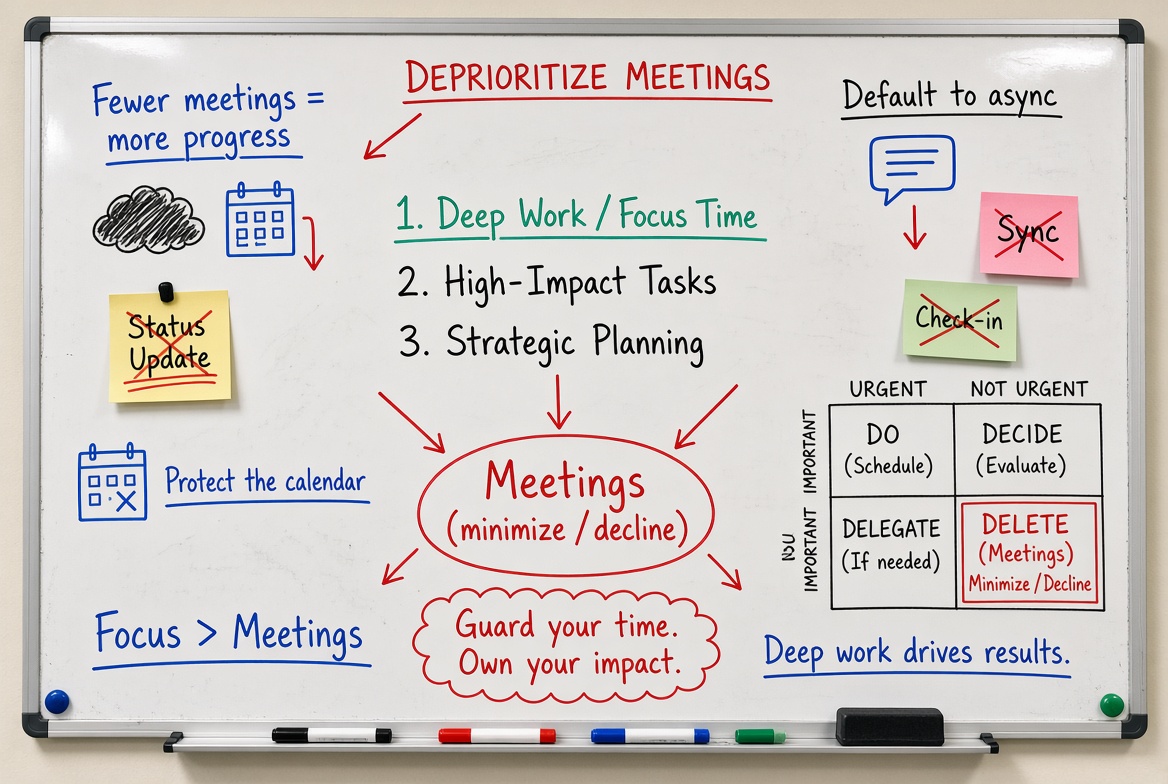
1. Deprioritization is a decision, not a drift
I spent a chunk of Friday declining recurring meetings. Every standing invite is an automatic withdrawal from your attention that renews forever until someone stops it — and the ones that outlive their purpose are exactly the ones nobody thinks to cancel, because canceling requires someone to decide.
Nothing falls off your plate on its own. It comes off because you take it off, on purpose, out loud, and you tell the organizer why. The half hour isn’t the real cost anyway; it’s the context switch on either side of it, and the quiet signal to your team that attending things is the job.
Takeaway: Put a recurring block on your own calendar to audit your other recurring blocks. Decline what no longer earns the half hour, and say why.
2. The integration usually isn’t the hard part
The connection between a new service and the target system worked on the first try. What blocked us was a network policy — the target only accepted traffic from internal services, and nobody had yet looked at which category we fell into.
This is the pattern almost every time. The technology works. The system boundary, the access model, and the question of who owns the decision are what stall you. People and system problems first. Technology problems second.
Takeaway: When you plan an integration, spend the first minutes on access and ownership.
3. Dogfood the tools you ask your team to adopt — and treat the friction as your backlog
I run AI agents across my own daily work: morning briefings, digging facts out of buried email threads, prepping for the next day. This week one of them caught a requests for me that I’d have walked past.
But the failures were the useful part. One agent couldn’t see my trackers because those connectors weren’t authorized — so its picture of my week was structurally incomplete. Another scanned exactly the folders it had access to, found them empty, and confidently told me there was nothing to organize. It was right about what it could see and wrong about my actual work.
That’s the whole lesson about agentic systems in one week: they’re only as good as their access to context, and the confident-but-partial answer is more dangerous than the obvious failure. Every point of friction I hit personally is a line item on the platform roadmap I’d otherwise never have found.
Takeaway: If you’re asking your organization to adopt something, use it yourself daily and keep a running list of everywhere it fails you. That list is key for your product backlog.
Leave a Reply